
Technical Bulletin: Proper Material Selection for Wire Rope Sleeves
Choosing the Correct Sleeve Material for a Given Wire Rope Material in a Known Service Environment
Sleeve and/or sleeve plating material selection for a particular wire rope material within a given environment is one of the most frequently asked questions of our Engineering Department. Material compatibility between the sleeve and cable remains a critical consideration to minimize corrosion and potential failure in service. The ideal material combination between any sleeve and wire rope is similar metals. However, some dissimilar-metal combinations are perfectly acceptable to meet performance and/or material availability requirements.
One should understand which material combinations of wire rope and sleeves are acceptable for a given environment to maximize galvanic corrosion prevention. The table below lists commonly accepted and used compatible sleeve/wire rope combinations for various environments. It refers to the wire rope materials as the large electrode (red), compared to the sleeve materials, which are smaller-area electrodes (blue). This is important in a galvanic couple, since it’s always preferable to have the smaller-area metal (sleeve) be cathodic (or more noble) relative to the larger-surface-area wire rope, which is better when it is anodic (more active).
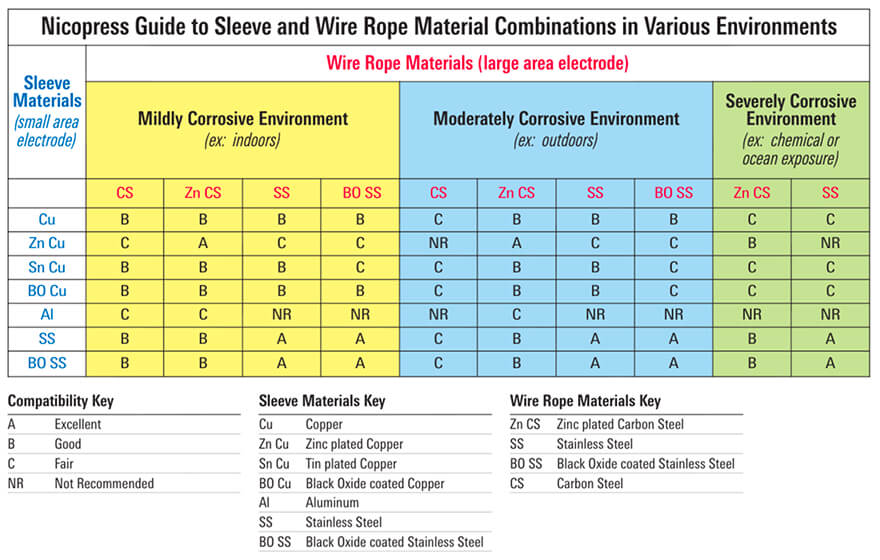
Note: All combinations of sleeves and wire rope in the above table represent “galvanic couples” where it is always preferable to have the “smaller area electrode,” or the metal sleeve, to be cathodic (or the more noble metal) relative to the “larger surface area electrode,” or wire rope, which is better when it is anodic (or a more active metal) in the couple.
Disclaimer: The information provided here serves as a general recommendation only. Many factors are involved in service environments, such as, but not limited to, temperature cycles and extremes, mechanical loading, electrical currents, radiation, chemicals, exposure methods (spray, immersion, or mists), exposure severity or frequency, and other conditions that may potentially vary or reverse an expected result.
Theory
Compressing a metal sleeve onto a wire rope or cable will form a dissimilar-metals couple if the sleeve material differs from the cable material. This dissimilar-metal couple, with an environmental catalyst, forms a galvanic cell that may generate a voltage and initiate a corrosive attack on one or both of the metals involved. To avoid possible galvanic corrosion, it is necessary to understand the materials involved and the service environment to which they will be exposed.
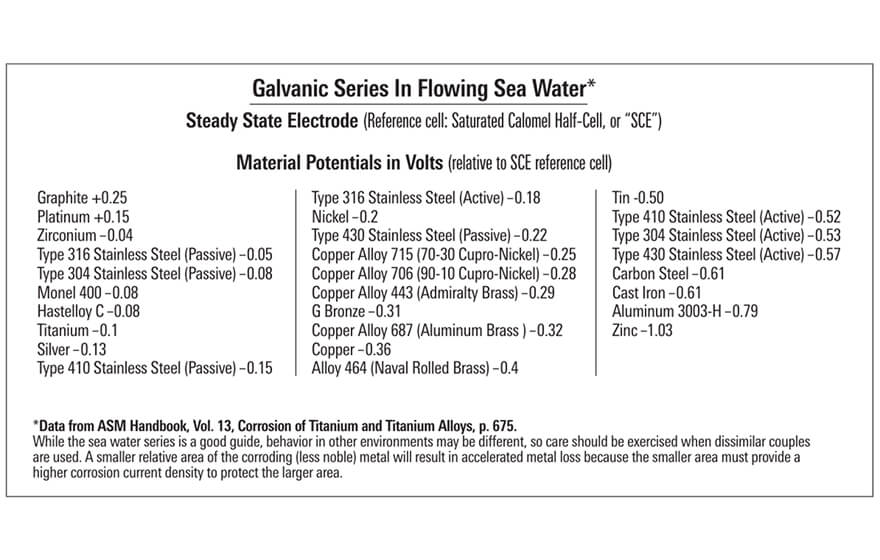
To assist with the proper coupling of dissimilar metals, the military standards committees, engineering societies, and many fastener companies have published various tables (referred to as “galvanic series”). These galvanic corrosion charts rank metals by their galvanic potentials (voltages) relative to a standard. As the numbers (galvanic potential) become more positive, the metal is considered more “cathodic,” “noble,” or “less active.” As the potential becomes more negative, the metal is considered more “anodic” or “active.”
Guidelines when using galvanic series tables (example from ASM below)
- When comparing two metals in a galvanic series table, the more positive metal is considered the cathode, and the other the anode.
- The material determined to be the cathode (C) should have a smaller surface area relative to the anode (A) surface area, or C/A ratio, to minimize corrosion. For example, a stainless steel (SS) sleeve over Al wire is acceptable. However, the reverse is not: i.e., an Al sleeve over stainless steel cable may severely corrode depending on the environment.
- The greater the numerical difference between the metals, the greater the likelihood of corrosion. For this reason, and if possible, select materials closer to each other in the galvanic series with differences between them less than 0.50V for room temperature environments.
Some historically acceptable combinations
- Copper sleeve over 304 SS steel wire rope with a lower potential difference = 0.28v but a high C/A >>1
- Sn-plated copper sleeve over 304 SS steel wire rope with a low potential difference = 0.42v but a high C/A >> 1
- Copper sleeve over galvanized steel wire rope with a higher potential difference = 0.67v but a low C/A << 1
- Other combinations of the same-material sleeve and wire rope with potential differences ≈ 0.0v, such as SS sleeve on SS wire rope and Zn-plated Cu sleeves on galvanized steel wire rope
Learn More About Galvanic Corrosion Prevention
Download a PDF of this technical bulletin, or contact our team with any questions about galvanic series in seawater and other environments.